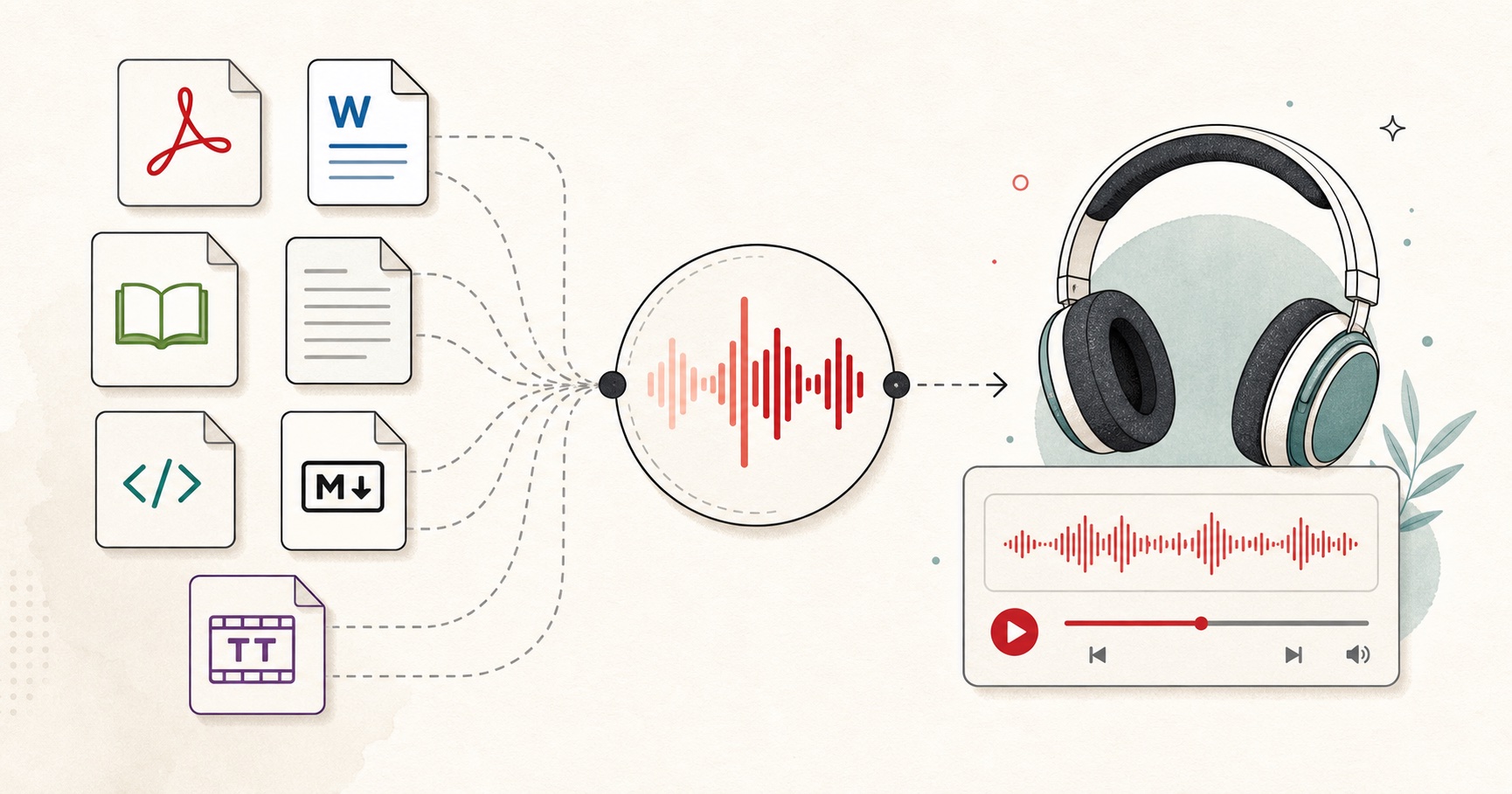
Listening to a PDF works best when the spoken sentence remains connected to its place on the page. Highlighting reduces the effort of finding your position and makes it easier to pause, reread, or correct extracted text.
This is a practical workflow for textbooks, papers, and reports: confirm the file contains text, import it locally, review the extracted sections, then listen with highlighting and resume.

Check whether the PDF contains text
Open the document and try selecting a sentence. If selection works, a browser reader can usually extract it. If the page behaves like a single image, it is a scanned PDF and requires OCR before ordinary text-to-speech can read it reliably.
A quick diagnosis:
- You can highlight words: it is a text-layer PDF. Continue.
- You can only select the whole page: it is likely a scan. Run OCR first.
- Mixed pages: some chapters will read and others will be silent. Review page by page.
FreeTextoSpeech does not pretend a photograph of a page is already speech-ready. If a page is empty after import, treat that as a detection result, not a voice failure.
Import and review sections
Use the Read PDF Aloud tool. The document is parsed locally, and only text selected for cloud speech generation is sent for processing. Review headings, footers, page numbers, and broken line wraps before listening.
Typical cleanup before you generate audio:
- Uncheck repeated headers and footers that would be spoken on every page.
- Join lines that were wrapped in the middle of a sentence.
- Skip reference lists or ads if you do not need them as audio.
- Keep captions and table titles if they carry meaning.
- Note pages that failed extraction so you can OCR them separately.
Do not generate the whole book until a representative page sounds right. One messy contents page can train you to ignore errors that then repeat for two hundred pages.
Follow and control the reading
Use sentence highlighting with previous and next controls. Keyboard shortcuts are useful when reading without a mouse. Select a difficult passage to replay it, and adjust speed without changing the original document.
Variable speed is for the listener, not for rewriting the PDF. Slow down for definitions and formulae. Speed up for a review pass you have already read. The source file stays untouched.
If a sentence is highlighted on the wrong fragment, the extraction is the problem. Fix the section text, then generate again. Chasing the highlight with a louder voice will not repair a broken line wrap.
Resume safely
Save the section and character position rather than the document body. A local document fingerprint can reconnect progress when the same file is opened again without storing its contents on a server.
That distinction matters for schoolwork, contracts, and unpublished drafts. Progress is a bookmark. The PDF should remain in storage you control.
When you export audio, download page clips or a joined file plus a manifest so you can return to a chapter without reconstructing the project from memory.
Choose a voice mode that matches the document
For confidential material, choose the on-device voice mode and confirm the privacy notice before starting. Cloud generation is often faster on low-powered devices, but the selected text leaves the browser for processing. Local extraction of the PDF is not the same thing as local speech.
A simple rule:
- Unpublished, client, medical, or legal text: prefer on-device speech.
- Public articles, marketing PDFs, or already-published papers: cloud speech is usually appropriate.
- Scanned archives: OCR first, then decide.
Read local vs cloud text-to-speech privacy if you need to inspect each stage of the pipeline.
A PDF listening checklist
- You can select text on the pages you care about, or you have OCR’d the scans.
- Headers, footers, and broken wraps were reviewed.
- Highlighting tracks the sentence you are hearing.
- Speed is set for this reading, not copied from another project.
- Resume data is a position, not an uploaded copy of the book.
- Voice mode matches the sensitivity of the document.