
Visual guide
How the how to write words phonetically tool presents input and output.
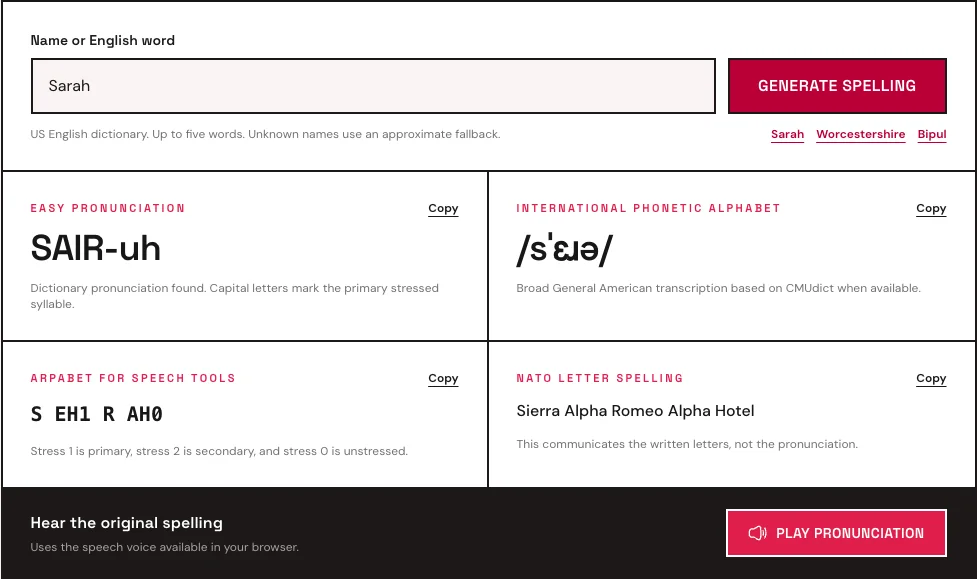
A usable phonetic spelling tells someone how the word sounds, not how clever the writer is. To write a name or word phonetically, split it into spoken syllables, use familiar sound clues, and capitalize the stressed syllable. “Sarah,” for example, can be written SAIR-uh. Our free phonetic spelling generator also produces IPA, ARPABET, and NATO spelling.
Start with the reader. A graduation announcer does not want a linguistics lesson five minutes before walking to the microphone. They need a clue that works at a glance. A language learner may want IPA, while a developer working with speech software may need ARPABET. Those are different jobs, so there is no single “best” phonetic spelling.
The test is wonderfully low-tech: hide the original word, read the pronunciation cue aloud, and see whether it gets you close.
Phonetic spelling represents how a word sounds rather than simply repeating its ordinary spelling. It is especially helpful when the written form does not make the pronunciation obvious.
Easy phonetic respelling uses familiar English letter patterns:
The capitalized part usually marks primary stress. Hyphens separate syllables. The spelling is intentionally approximate because ordinary English letters cannot represent every speech sound consistently.
IPA, or the International Phonetic Alphabet, is different. It uses standardized symbols so the same sound can be represented consistently across words and languages.
Use the following process:
Suppose the name is “Adriana.” One pronunciation can be divided as:
ah-dree-AH-nuh
The syllable AH is capitalized because it receives the main stress. The final nuh indicates that the final vowel is reduced rather than pronounced as a strong “a.”
Names do not have one universal pronunciation. Adriana may be pronounced differently across languages, regions, and families. The person who owns the name is the authority.
Syllable boundaries make a respelling readable. Compare these versions:
sairuhSAIR-uhThe second version immediately communicates two pieces and shows which one is stronger.
You do not need to reproduce a dictionary’s exact linguistic syllabification. Your goal is to help the intended reader produce the correct sound. Place boundaries where they make the pronunciation easiest to understand.
Common patterns include:
MY-kuhlJEN-uh-furuh-MAN-duh-leeRead every segment independently. If one segment looks like a different familiar word, change the respelling to remove that ambiguity.
Stress affects whether a pronunciation sounds natural. English speakers make a stressed syllable longer, louder, or clearer than nearby unstressed syllables.
Capital letters are an easy way to show stress:
REH-kurd for the noun “record”rih-KORD for the verb “record”The letters are almost the same, but the stress changes the word’s function and sound.
For a long name, capitalize only the syllable with primary stress. Too much capitalization removes the visual cue.
Vowels cause most confusion in English respelling. The same written vowel can represent several sounds, so use a familiar cue that matches what you hear.
| Respelling | Example sound |
|---|---|
ee | see, tree |
ih | sit, bit |
eh | bed, met |
ay | day, face |
eye | my, time |
ah | father, palm |
aw | saw, thought |
oh | go, home |
oo | food, blue |
uh | about, mother |
ow | now, out |
oy | boy, choice |
Regional accents change these comparisons. A respelling written for a US English reader may not guide a British, Indian, or Australian English speaker in exactly the same way.
Easy respelling and IPA have different strengths.
Use easy spelling when the reader does not have phonetics training. It is appropriate for:
Its weakness is inconsistency. Two people may interpret ah differently.
Use IPA when precision matters and the reader knows the symbols. IPA distinguishes sounds that ordinary spelling often merges.
It is useful for:
The phonetic spelling generator provides both formats for US English dictionary entries, allowing you to choose the version that fits the audience.
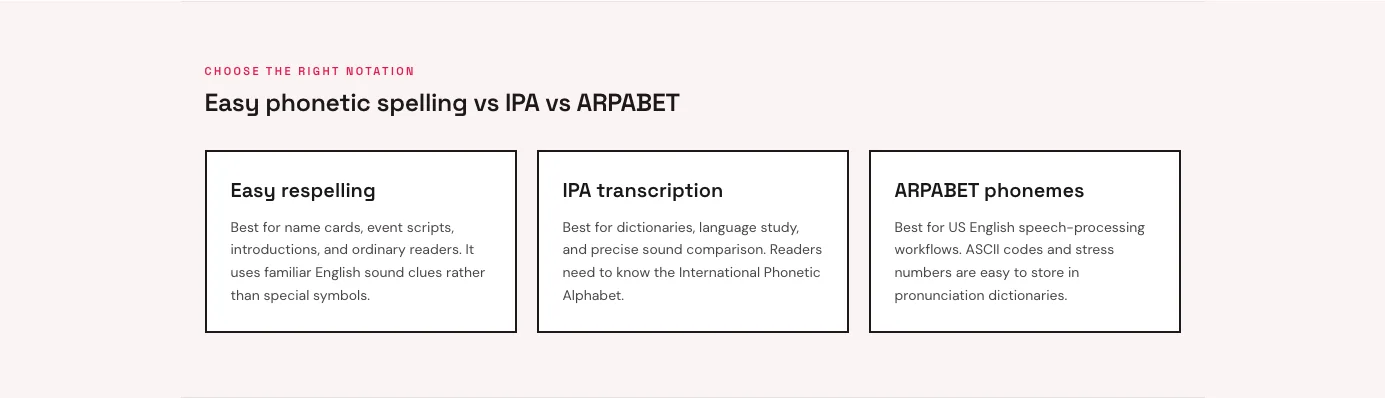
ARPABET represents English speech sounds with ordinary ASCII letters. It was developed for speech research and is used by the CMU Pronouncing Dictionary.
The word “hello” appears as:
HH AH0 L OW1
The letter groups represent phonemes. The numbers attached to vowel sounds represent stress:
0: unstressed1: primary stress2: secondary stressARPABET is not meant to look natural to an ordinary reader. It is useful for software, pronunciation dictionaries, speech synthesis, and language-processing experiments.
Text-to-speech systems can mispronounce names, abbreviations, brands, and specialized vocabulary. When the tool does not support a custom pronunciation dictionary, an easy phonetic workaround can help.
For example, if a name is misread, replace it temporarily with a spelling that produces the intended sound. Then generate a short test before processing the whole script.
Use this workflow:
Different speech models interpret invented spellings differently. A respelling that works in one voice may need adjustment in another language or accent.
Do not replace the visible written name in captions or public text. Use the phonetic version only in the narration input when necessary.
Event scripts should be easy to scan under pressure. Put the phonetic spelling immediately after the name and keep the notation consistent.
Example:
Aaliyah Thompson (uh-LEE-uh TOM-sun)
Good event pronunciation notes:
For a graduation or award ceremony, collect pronunciation information directly from participants. Automated output should be a starting point, not the final authority.
A familiar spelling can have several pronunciations across cultures or families. Ask instead of treating the dictionary version as definitive.
NATO spelling communicates letters, not pronunciation. “Bipul” as “Bravo India Papa Uniform Lima” helps someone type the name correctly but does not tell them how to say it.
Correct consonants and vowels can still sound wrong when the stress falls on the wrong syllable.
If your cue contains a syllable that could be read two ways, add a rhyming example or choose another sound spelling.
A browser voice predicts pronunciation from spelling. It does not know a person’s preference. Use audio as a test, then confirm human names with humans.
The NATO phonetic alphabet assigns a standard word to each letter: Alpha for A, Bravo for B, Charlie for C, and so on.
It is designed for communicating spelling over radio or phone connections. It answers “Which letters are in this word?” rather than “How does this word sound?”
For example:
Both outputs are useful, but they solve different problems.
A dictionary-based result can be reliable for common US English words and many familiar names. Accuracy drops for:
Our tool marks unknown entries as approximate rather than pretending the prediction is certain. That distinction matters. Pronunciation is personal and contextual.
Before using the result:
The best phonetic spelling is the one the reader can use. If səˈɹɑː helps your audience, use IPA. If it makes them stare at the page in panic, write suh-RAH instead.
Open the free phonetic spelling generator, enter a name or English word, and compare the easy pronunciation, IPA, ARPABET, and NATO outputs. Copy the version your audience understands. Better still, ask the person whose name it is. They outrank every dictionary.
Visual guide
How the how to write words phonetically tool presents input and output.
In context
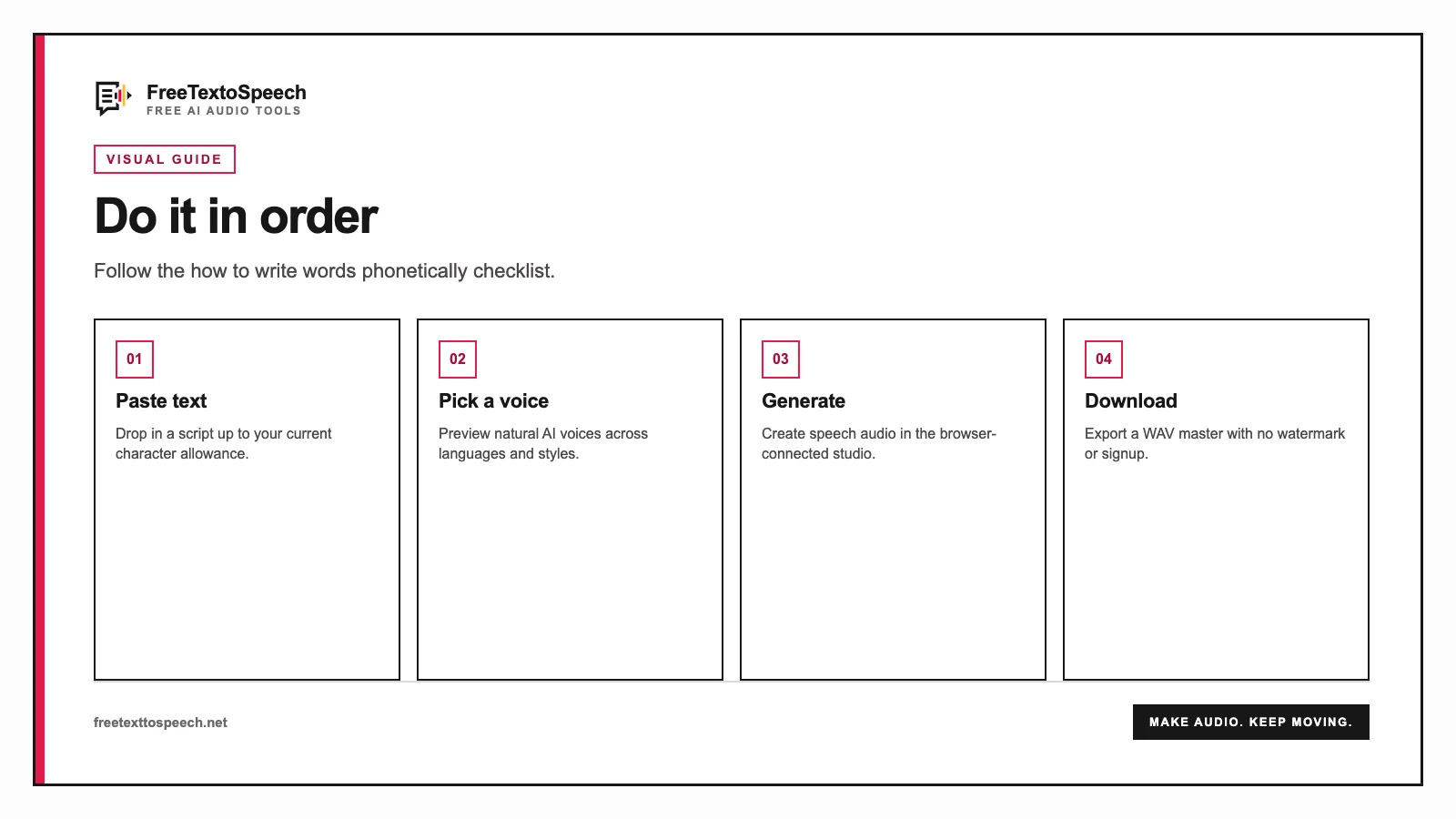
A step-by-step visual guide for how to write words phonetically.
A tiny favor
Allow ads for this site, then check again. Prefer no ads? Support us to unlock ad-free access and 2 million cloud characters.
Allow ads for freetexttospeech.net, then check again.
Already supporting us? Sign in to restore your perks.
Send feedback
Tell us what you think
Bugs, ideas, or anything that would make FreeTextoSpeech better.
