Long-form narration
Sarah, River, and Bella hold pace and tone over hour-long passages, built for audiobooks and documentaries.
You've hit the free limit
Free tier: 5,000 characters/month
You've used all 5,000 free characters for this month. Sign in with Google to get 500,000 characters per month, free, no credit card.
You've used your 500,000 characters for this 30-day window. Your allowance resets automatically, thanks for using FreeTextoSpeech.
Natural text to speech with neural voices that sound like a real person reading. Powered by Kokoro, free forever.
Ten years ago, 'text to speech' meant robotic phonemes glued together. Today, open models like Kokoro deliver voices indistinguishable from human narration for most everyday listeners, and FreeTextoSpeech hosts them for free with realistic prosody, micro-pauses, and accurate pronunciation.
Related use cases
Use the most natural Kokoro voices, Sarah, Bella, River, Liam for US, Emma for UK. Write naturally with commas and line breaks (the model uses them as prosody cues), generate at 1.0×, and download the WAV. Indistinguishable from a real narrator for most listeners.
Use commas, semicolons, and line breaks for pauses. The model responds to punctuation as prosodic cues.
Sarah, Bella, River, Liam, or Emma (UK), the most natural-sounding voices in the catalog. Preview to compare.
Stay at native speed for the most natural prosody. Adjust later if needed for pacing.
24 kHz WAV, commercial license. Drop into your video editor, podcast DAW, or course authoring tool.
Sarah, River, and Bella hold pace and tone over hour-long passages, built for audiobooks and documentaries.
Liam and Adam deliver friendly, natural reads ideal for explainer videos and software walkthroughs.
Emma and Daniel bring authentic British prosody, for travel content, history channels, and BBC-style narration.
Native-locale voices for Spanish, French, Hindi, Italian, Japanese, Portuguese, and Mandarin, no compromises.
Still wondering? Get in touch →
Why this generator is genuinely free, no trial.
Studio-quality reads for full YouTube videos.
Indie audiobook narration with full commercial rights.
Studio-quality reads for podcast intros and segments.
Free, natural, instant.
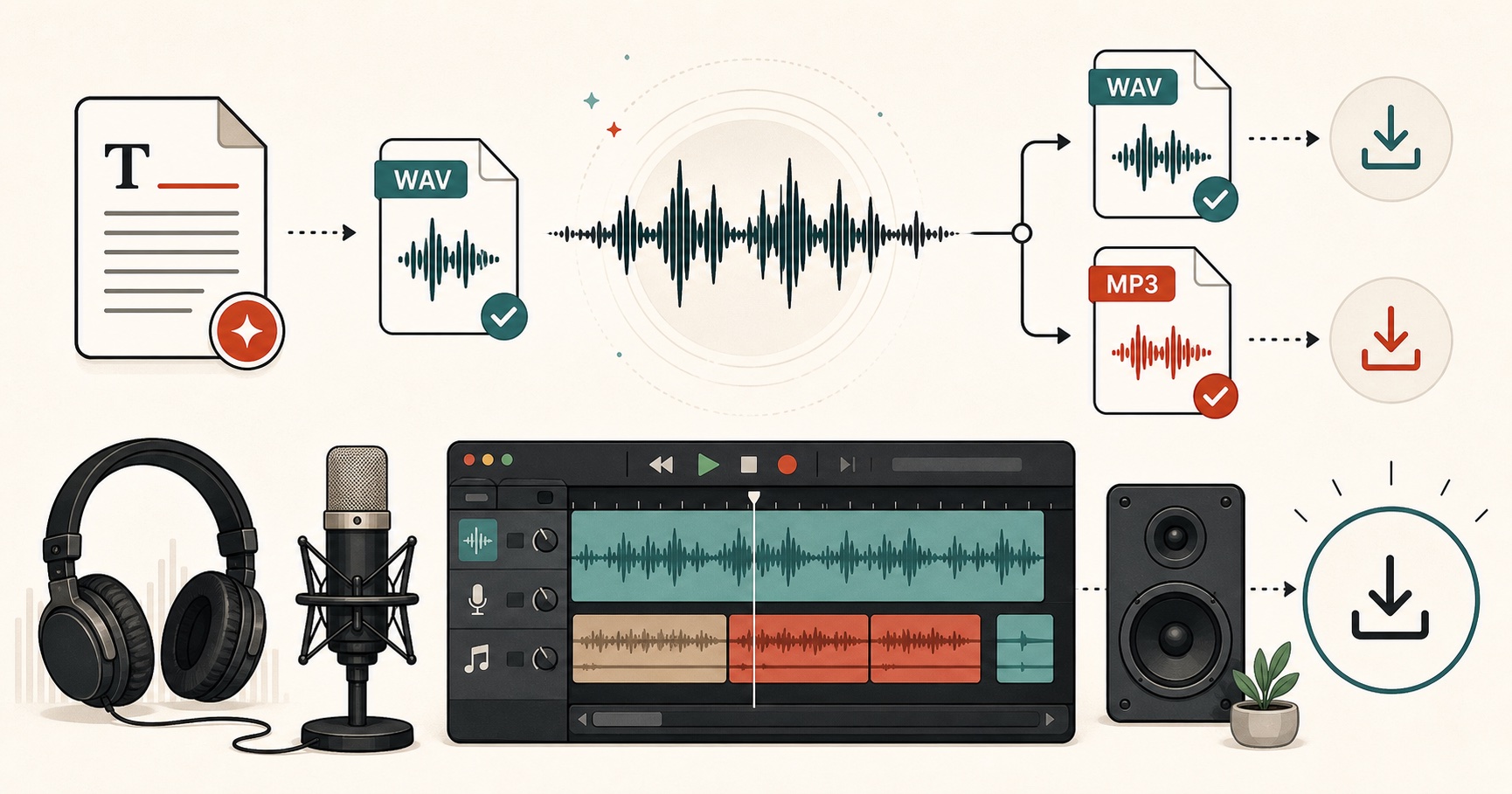
Visual guide
An audio export guide for WAV, MP3, and production-ready speech files.